

Female Hair Transplant UK: Expert FUE for Women at 8 UK Clinics
Restore your natural density and confidence with specialised, minimally invasive hair restoration designed for women.
Female Hair Loss: Causes and Types
Hair loss affects up to 50% of women at some point in their lifetime. Unlike male pattern baldness, female hair loss often presents as diffuse thinning across the scalp rather than a receding hairline, making it less visible but no less distressing. Hair Growth Centre treats female hair loss every day across 8 UK clinics.
Female Pattern Hair Loss (Androgenetic Alopecia)
Female pattern hair loss, also known as androgenetic alopecia, is the most common form of hair loss in women. It is caused by a combination of genetic factors and hormonal changes, particularly during menopause. Hair thins gradually across the top and crown of the scalp while the frontal hairline is usually preserved. See our Ludwig Scale guide for the stages of female pattern hair loss.
The Ludwig Scale: Stages of Female Hair Loss
The Ludwig Scale classifies female hair loss into three stages. Ludwig I is mild thinning at the top of the scalp. Ludwig II is more visible thinning with a widening of the central parting. Ludwig III is severe diffuse thinning with the scalp clearly visible. Stages I and II are typically the most suitable for hair transplant. See our full guide to Hair Loss in Women.
Other Causes of Hair Loss in Women
- Telogen effluvium: temporary shedding triggered by stress, illness, childbirth or major surgery.
- Alopecia areata: an autoimmune condition causing patchy hair loss.
- Traction alopecia: hair loss caused by tight hairstyles over time.
- Frontal fibrosing alopecia: a scarring condition causing hairline recession. Note: hair transplant is not suitable for all of these causes. Diagnosis at consultation is essential.
Can Women Have a Hair Transplant?
Yes. Hair transplant is a safe and effective option for women with the right type and pattern of hair loss. The key difference between male and female transplant candidacy is the donor area. Women typically retain hair across more of the scalp, which can make donor extraction more complex. This is why choosing a clinic experienced in female hair transplant specifically is important.
Who Is a Suitable Candidate
- Women with stable female pattern hair loss at Ludwig stages I or II.
- Women with traction alopecia where the cause has been addressed.
- Women with hairline recession caused by androgenetic alopecia.
- Patients with sufficient donor hair density at the back and sides of the scalp.
- Both younger and older women depending on stability of hair loss.
Who May Not Be Suitable
- Women with active, rapidly progressing diffuse thinning.
- Women with telogen effluvium where the underlying cause has not been resolved.
- Women with alopecia areata where the autoimmune activity is ongoing.
- Women with scarring alopecia conditions.
- Your surgeon will provide an honest assessment at your free consultation.
The Importance of a Proper Diagnosis First
Before any transplant discussion, a proper diagnosis of the cause of hair loss is essential. Hair Growth Centre includes a thorough scalp and hair assessment as part of every free consultation. Treating the wrong type of hair loss with a transplant produces poor results. We will always tell you honestly if transplant is not the right option for you.
Female Hair Transplant Using FUE
Hair Growth Centre uses FUE (Follicular Unit Extraction) for female hair transplant. FUE extracts individual hair follicles from the donor area and implants them into thinning or receding areas of the scalp. For female patients, the technique is adapted to account for the different hair loss patterns and donor area characteristics of women.
How FUE Works for Female Patients
In female FUE, the donor area is typically a strip across the back of the scalp rather than the full back and sides used in male procedures. This minimises visible changes to the donor area while providing sufficient grafts for natural-looking restoration.
Donor Area Placement for Women
For most female patients, a small section of hair is shaved in the donor area for extraction. The surrounding hair covers this area immediately after the procedure, making it invisible. Alternatively, Unshaven FUE is available for patients who cannot have any visible shaving at all.
Unshaven FUE: No Head Shave Required
Hair Growth Centre offers Unshaven FUE specifically for female patients who cannot shave any part of their head. The procedure is performed through existing hair with no visible change to the donor area during or after treatment. This option is not offered at most UK clinics and is one of the key reasons female patients choose Hair Growth Centre.
How Many Grafts Does a Female Transplant Need?
The number of grafts depends on the extent and pattern of thinning. Female transplants typically require between 1,000 and 2,500 grafts. Ludwig I patients at the lower end, Ludwig II at the higher end. Your exact graft count is confirmed at your free consultation.
The Procedure Step by Step
A female hair transplant at Hair Growth Centre is performed under local anaesthetic and typically takes between 4 and 7 hours depending on the number of grafts required. You go home the same day.
Free Consultation and Diagnosis
Your surgeon assesses your hair loss type, Ludwig stage, donor hair density, and goals. A diagnosis of the cause of hair loss is made before any transplant discussion proceeds.
Hairline and Design Planning
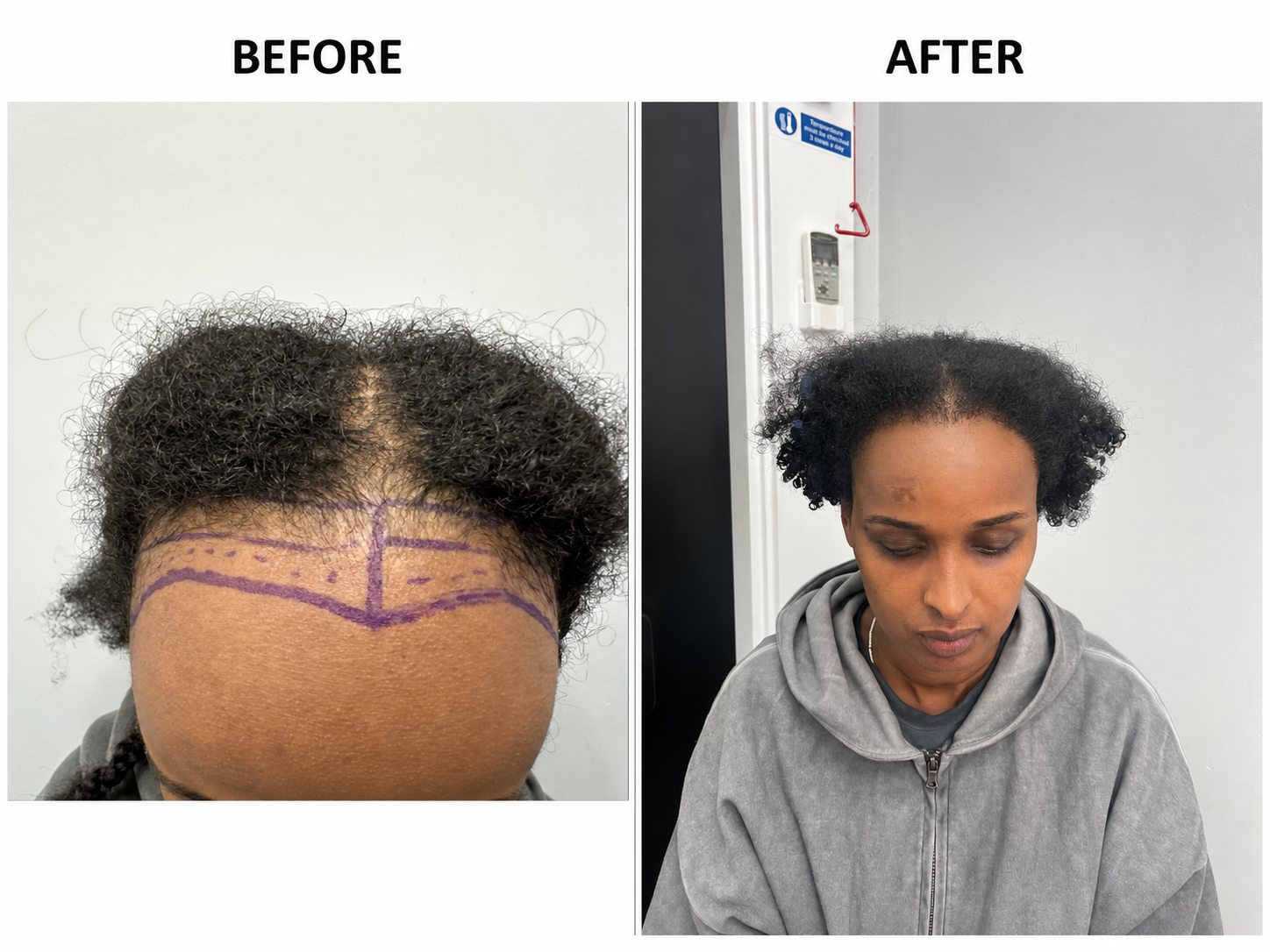
The transplant area and coverage plan are agreed with you before the procedure begins. For hairline cases, the new hairline position is drawn on the scalp for your approval.
Graft Extraction
Follicles are extracted from the donor area. For most female patients a small shaved strip is used. For Unshaven FUE patients no shaving is required at any point.
Graft Implantation
Grafts are implanted at the correct angle and density for natural-looking coverage across the thinning area. Female hair growth patterns are mapped precisely by the surgeon.
Aftercare and Recovery
You go home the same day with full written aftercare instructions. Follow-up appointments are included. New growth begins at 3 to 4 months.
Female Hair Transplant Results
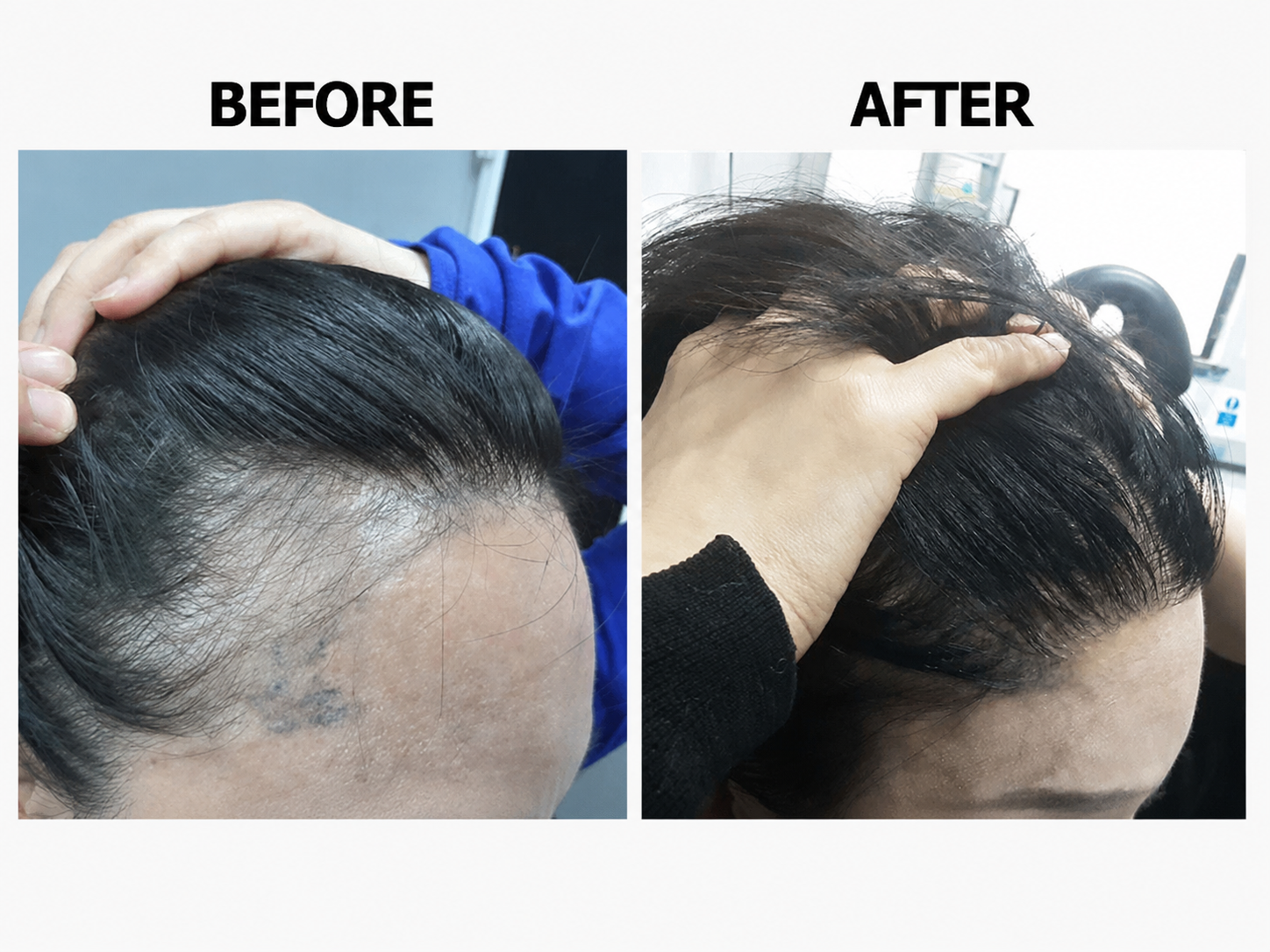
Browse results from female patients treated at Hair Growth Centre clinics. Each case is different and results depend on the type and extent of hair loss, graft count and individual response.
Recovery After Female Hair Transplant
Recovery after female hair transplant follows the same timeline as FUE procedures generally. Most female patients find the process manageable and return to normal activities quickly.
Initial Healing
Mild redness and small scabs. Return to desk work within 3 to 5 days. Avoid heat styling and tight hairstyles.
Shock Loss Phase
Transplanted hairs shed. This is completely normal. The follicles remain intact and will produce new growth.
New Growth Begins
New hair growth begins from the transplanted follicles. Fine at first, gradually thickening.
Full Results
The majority of density develops. Full results visible at 12 months. Diffuse thinning improvement may continue beyond 12 months.
Non-Surgical Alternatives for Women
Hair transplant is not the right option for every woman with hair loss. For patients who are not yet suitable candidates, or who prefer a non-invasive approach, Hair Growth Centre offers effective non-surgical treatments.
Natural Hair Restoration
A non-invasive treatment to stimulate hair regrowth and improve scalp health. Suitable for women with diffuse thinning who are not yet ready for or suitable for transplant.
Find out more →Low Level Laser Therapy
Clinically studied light-based treatment to stimulate follicle activity and slow hair loss progression. Available at Hair Growth Centre clinics.
Find out more →What Our Female Patients Say
"I was nervous about the process as a woman but the team at Hair Growth Centre were incredibly understanding and professional throughout. The results at 10 months have restored my confidence completely."
"The Unshaven FUE option was the reason I chose Hair Growth Centre. I could not have any visible shaving for my job and they delivered exactly what they promised. Brilliant experience."
"As a female patient I was worried my hair loss was too diffuse for a transplant. The surgeon was honest with me at consultation and we agreed on the right approach. I am thrilled with the result."
Frequently Asked Questions
Can women have a hair transplant?
-Yes. Hair transplant is a clinically proven option for women with the right type of hair loss, particularly female pattern hair loss caused by androgenetic alopecia. A free consultation will confirm whether you are a suitable candidate.
What causes hair loss in women?
+Is FUE suitable for female hair loss?
+How many grafts does a female hair transplant need?
+Will I need to shave my head for a female hair transplant?
+How long does female hair transplant recovery take?
+What is the difference between male and female hair transplant?
+Can a hair transplant treat diffuse thinning in women?
+How much does a female hair transplant cost in the UK?
+Other Procedures and Treatments
Hair Growth Centre offers a full range of hair transplant procedures and non-surgical treatments for men and women across 8 UK clinics.
WHAT ARE YOU WAITING FOR?
Take your first step towards counteracting your hair loss and gaining your full head of hair back. Simply fill in the online enquiry form and let us take care of the rest, it’s as easy as that. We promise you won’t be disappointed.